

Every spring in Massachusetts, homeowners step outside after months of brutal cold and begin to notice things they could not see in the fall. Cracks along the foundation. Crumbling mortar between stones. Small gaps that were not there before. These are not cosmetic issues. They are the visible aftermath of one of the harshest seasonal cycles any structure can endure, and they demand attention before the damage compounds through summer humidity and the next round of freezing temperatures.
Understanding why winter does what it does to a foundation, and why spring is the right time to act, starts with understanding how Massachusetts weather works against your home from the ground up.
How Frost Damage Foundation Issues Develop During a Massachusetts Winter
Massachusetts winters are relentless. Temperatures regularly swing above and below the freezing point multiple times in a single week, and that cycle of freezing and thawing is far more destructive to masonry than sustained cold ever could be. When water seeps into the small pores and cracks of a stone or brick foundation, it expands by roughly nine percent when it freezes. That expansion pushes outward against the mortar joints and the stone itself. When temperatures rise again and that ice melts, the water retreats, leaving a slightly larger gap behind. Then it freezes again.
This process, repeated dozens of times over a single winter in MA, is what engineers and masons refer to as frost heave and freeze-thaw cycling. Over months, the cumulative effect is significant. Mortar joints that were slightly worn in October may be visibly deteriorated or missing entirely by March. Stone foundations that absorbed moisture through late fall are especially vulnerable because they hold water at multiple depths, meaning the expansion is not limited to the surface.
Frost damage foundation issues are not limited to older homes, either. Even foundations constructed in the past few decades can show meaningful deterioration after a particularly wet fall followed by a hard Massachusetts winter. The soil around the foundation also shifts as it freezes and thaws, putting lateral pressure against the base of the structure in ways that widen existing cracks or create new ones.
What Foundation Damage After Winter Looks Like in MA
Knowing what to look for helps homeowners make informed decisions before calling a professional. Foundation damage after winter in Massachusetts tends to follow recognizable patterns, though the severity varies based on the age of the structure, the type of foundation material, and how well the foundation was maintained going into the cold season.
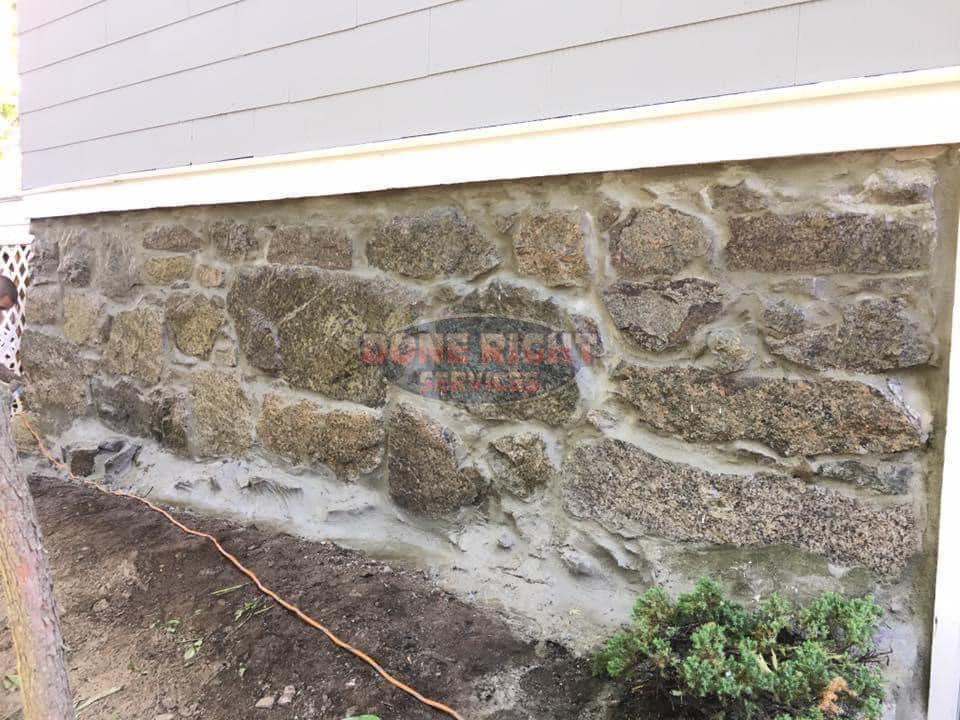
In stone foundations, which are extremely common in older Massachusetts homes, the most frequent sign of damage is deteriorated mortar. The mortar between the stones is the binding agent that holds everything together and prevents water infiltration. When it wears away, water gets in more easily, the stones shift slightly under load, and the structural integrity of the foundation begins to decline. Homeowners may notice powdery residue at the base of the foundation wall, gaps between stones that were previously tight, or sections where the mortar has crumbled out entirely.
Horizontal cracks in a foundation are among the more serious signs to watch for, as they can indicate that soil pressure from frost heave has pushed inward against the wall. Vertical cracks are also common and often point to settling or differential movement caused by frozen and thawed ground beneath the footing. Stair-step cracks in brick foundations follow the mortar joints and are a classic indicator of frost-related movement in MA.
Water staining on the interior of a basement wall is another red flag. If moisture has been working its way through compromised mortar joints all winter, the evidence tends to show up in spring as efflorescence (white mineral deposits), damp patches, or even small pools on the basement floor.
Why Stone Foundation Repointing in MA Should Happen in Spring
Spring is not just a convenient time to address foundation issues. It is genuinely the best time from a practical and technical standpoint. Once winter loosens its grip on Massachusetts, soil conditions stabilize, temperatures rise above the threshold needed for mortar to cure properly, and the full extent of frost damage foundation problems becomes visible.
Stone foundation repointing in MA refers to the process of removing deteriorated mortar from the joints between stones and replacing it with fresh mortar that bonds properly, seals against water intrusion, and restores the structural cohesion of the wall. It is one of the most effective and cost-efficient repairs a homeowner can make to a masonry foundation.
The reason timing matters so much is that mortar needs consistent temperatures above 40 degrees Fahrenheit to cure correctly. Work done too early in the season can result in mortar that freezes before it sets, which defeats the purpose entirely. Spring in Massachusetts, particularly from mid-April through June, offers reliable conditions for repointing work to be completed properly.
Beyond the curing requirements, spring repointing gives the repaired foundation an entire warm-weather season to dry, harden, and settle before the next freeze-thaw cycle begins. That matters because new mortar that has had months to fully cure performs dramatically better when winter arrives again compared to mortar applied too close to the cold season.
Addressing spring foundation repair in MA before summer also prevents a common mistake: assuming that because the weather is good, the problem can wait. Deteriorated mortar wicks moisture throughout the summer. That moisture feeds biological growth inside the wall, accelerates the breakdown of adjacent mortar, and sets the foundation up for even worse damage the following winter.
Choosing the Right Approach to Spring Foundation Repair in MA
Not all foundation repairs are the same, and not all repointing jobs require the same approach. The type of stone, the original mortar composition, and the extent of the damage all factor into what materials and methods are appropriate.
One of the most important considerations in Massachusetts is using a mortar that matches the original in terms of hardness and composition. Older stone foundations were often built with lime-based mortars that are softer and more flexible than modern Portland cement-based mixes. Applying a hard modern mortar to a soft historic stone can actually accelerate damage because the stone itself becomes the weak point rather than the mortar joint, which is designed to be sacrificial.
A qualified mason familiar with historic and period construction in MA will assess the existing mortar composition before selecting a replacement mix. This is not a step to skip, particularly for homes built before the mid-20th century. The wrong mortar can cause more harm over a decade than doing nothing at all.
For homeowners dealing with more extensive foundation damage after winter, repointing may be one component of a broader repair plan that includes crack injection, drainage improvements, or in serious cases, underpinning. A structural assessment by a licensed engineer or experienced foundation contractor is the appropriate starting point when the damage extends beyond surface mortar deterioration.
Spring is also an ideal time to address grading around the foundation, ensuring that water flows away from the structure rather than pooling against it, which reduces future moisture infiltration.
Conclusion
Post-winter foundation damage in Massachusetts is a predictable consequence of the state’s climate, but it is not inevitable as a long-term problem. Stone foundation repointing in MA, done properly in spring, addresses the most common form of frost damage before it escalates into something far more costly. Homeowners who make spring foundation repair in MA a seasonal habit protect not just their foundation but the entire structure above it. The investment is modest compared to what deferred maintenance eventually demands.
Need The Best Foundation Crack Repair Specialist Near You?
At Done Right Services, we’ve been the trusted name in masonry since 1998, offering top-notch stone foundation repairs, crack repairs, and basement waterproofing throughout Massachusetts and New Hampshire. Our team of experts is dedicated to restoring your home’s foundation and ensuring your basement stays dry and safe. With our lifetime warranty and 15-year money-back guarantee on all concrete foundation services, you can trust that we’ll handle your needs with precision and care. Don’t let water leaks or foundation issues damage your home—reach out to us and experience the Done Right difference today!